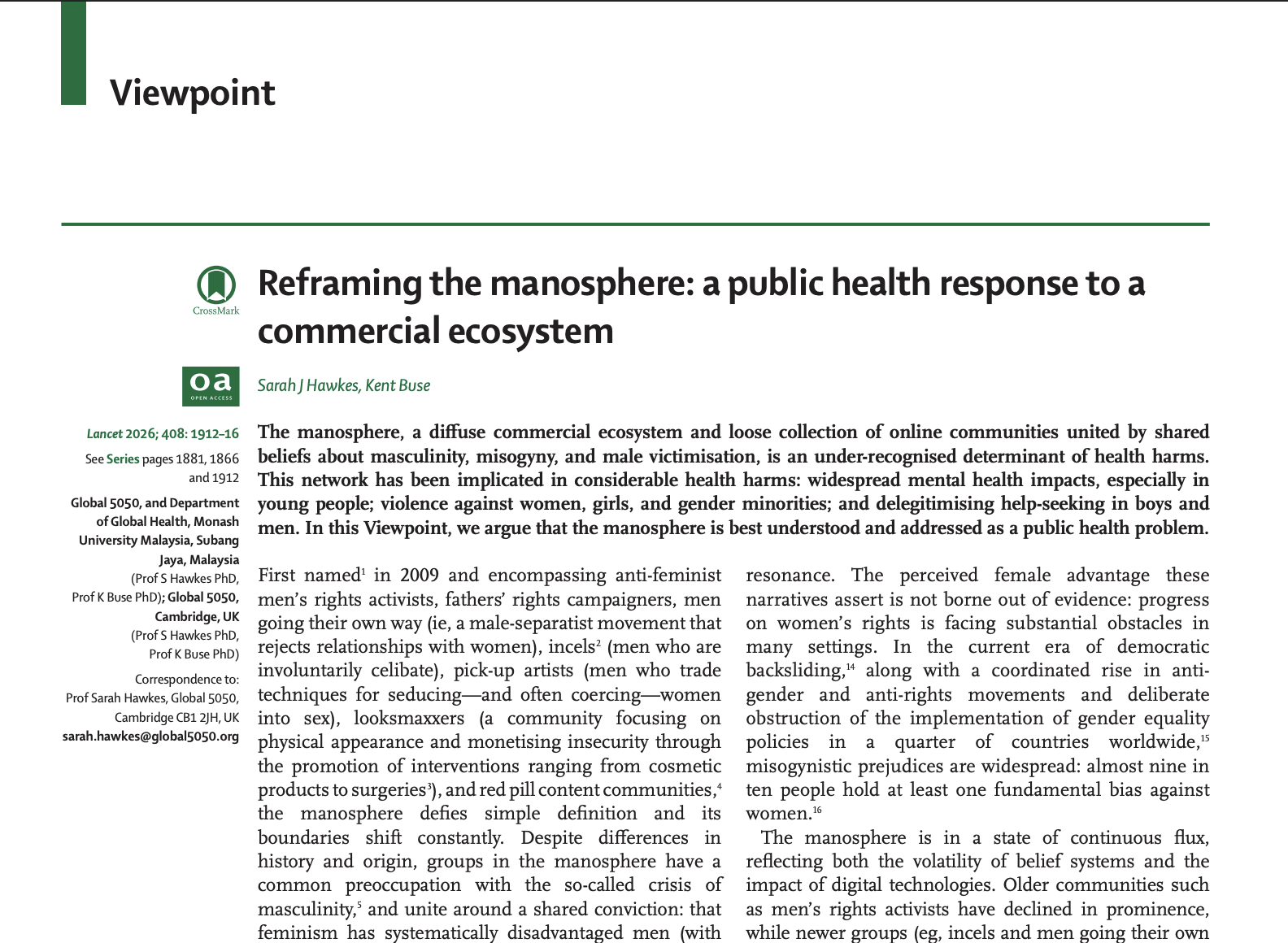
Reframing the manosphere: a public health response to a commercial ecosystem
Lancet Viewpoint by Sarah Hawkes and Kent Buse

The manosphere is not a passing backlash. It is an organised, networked and often highly profitable ecosystem that thrives on existing inequality, and it demands a public health response.
What is the manosphere?
The manosphere is a loose, constantly shifting collection of online communities, including men’s rights activists, incels, pick-up artists, looksmaxxers, men “going their own way” and red pill content communities. They differ in history and origin but share a conviction that feminism has systematically disadvantaged men. Studies also document crossover with racism, antisemitism and anti-LGBTQ+ discourse.
It is also a commercial ecosystem. Revenue comes from advertising, subscriptions and content creation, and platform algorithms prioritise engagement and controversy, so outrage and grievance are good for business. Part of that revenue is extracted directly from young users, who are sold subscriptions, courses, surgeries and financial investment schemes that monetise the very insecurities the content cultivates.

This is a business model, not a fringe. Outrage and grievance are good for business, so the system rewards the most extreme content. Public health has a tested toolkit for commercial harms and we should use it.Professor Kent Buse, co-founder, Global 50/50
Why is the manosphere a public health issue?
The manosphere is an under-recognised determinant of health harms. As Global 50/50 Co-CEOs set out in the Lancet, it has been implicated in widespread mental health impacts, especially in young people; in violence against women, girls and gender minorities; and in delegitimising help-seeking in boys and men.
Although rigorous causal evidence is currently scarce, the manosphere is associated with health harms, both directly and indirectly. Its narratives of dominance, entitlement and sexual rejection normalise misogynistic attitudes and heighten the risk of violence against women, girls and gender-diverse people, while boys and men engulfed in it are trapped in narratives of grievance, fatalism and stigma against help-seeking.
Like the tobacco and ultra-processed food industries, content creators and hosting platforms deploy strategies that individualise responsibility. Men’s problems are framed as the result of feminism rather than structural conditions, and efforts to regulate or moderate content are frequently framed as threats to men’s autonomy.
Boys and men, particularly those marginalised by social and structural drivers, experience substantial unmet need from health policies, systems and services. The manosphere redirects blame for these problems to women and feminism rather than the structural and economic forces responsible. For many boys and men, its communities offer what mainstream institutions have not: belonging, identity and a coherent explanation for failure.
This misattribution is precisely why content moderation alone is insufficient. Restricting manosphere content does nothing to address the unmet needs that make its explanation attractive in the first place.
Although the manosphere did not create misogyny, it is normalising and amplifying it. Framing it as a public health problem shifts the focus from narrow strategies of content moderation, access safeguards or algorithm diversion to the underlying drivers of harm. The harms to boys and men, to women and girls, and to wider society provide a clear basis for action.
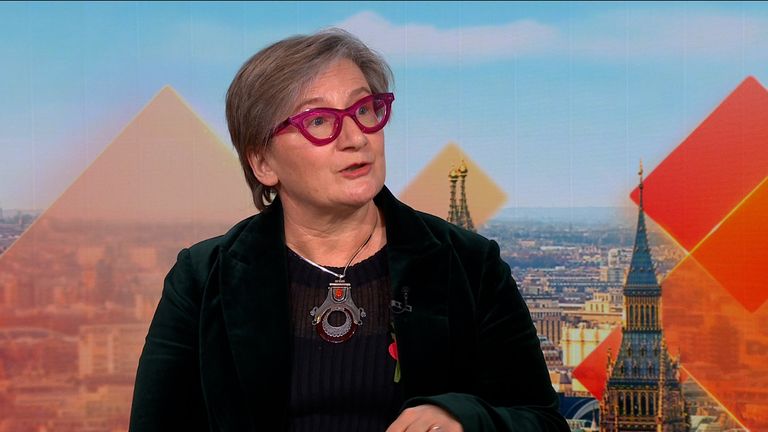
The manosphere offers boys and young men belonging, identity and an explanation for why life feels hard. Those needs are real. A response that only removes the manosphere, without offering something credible in its place, will fail.Professor Sarah Hawkes, co-founder, Global 50/50
Lancet Viewpoint by Sarah Hawkes and Kent Buse
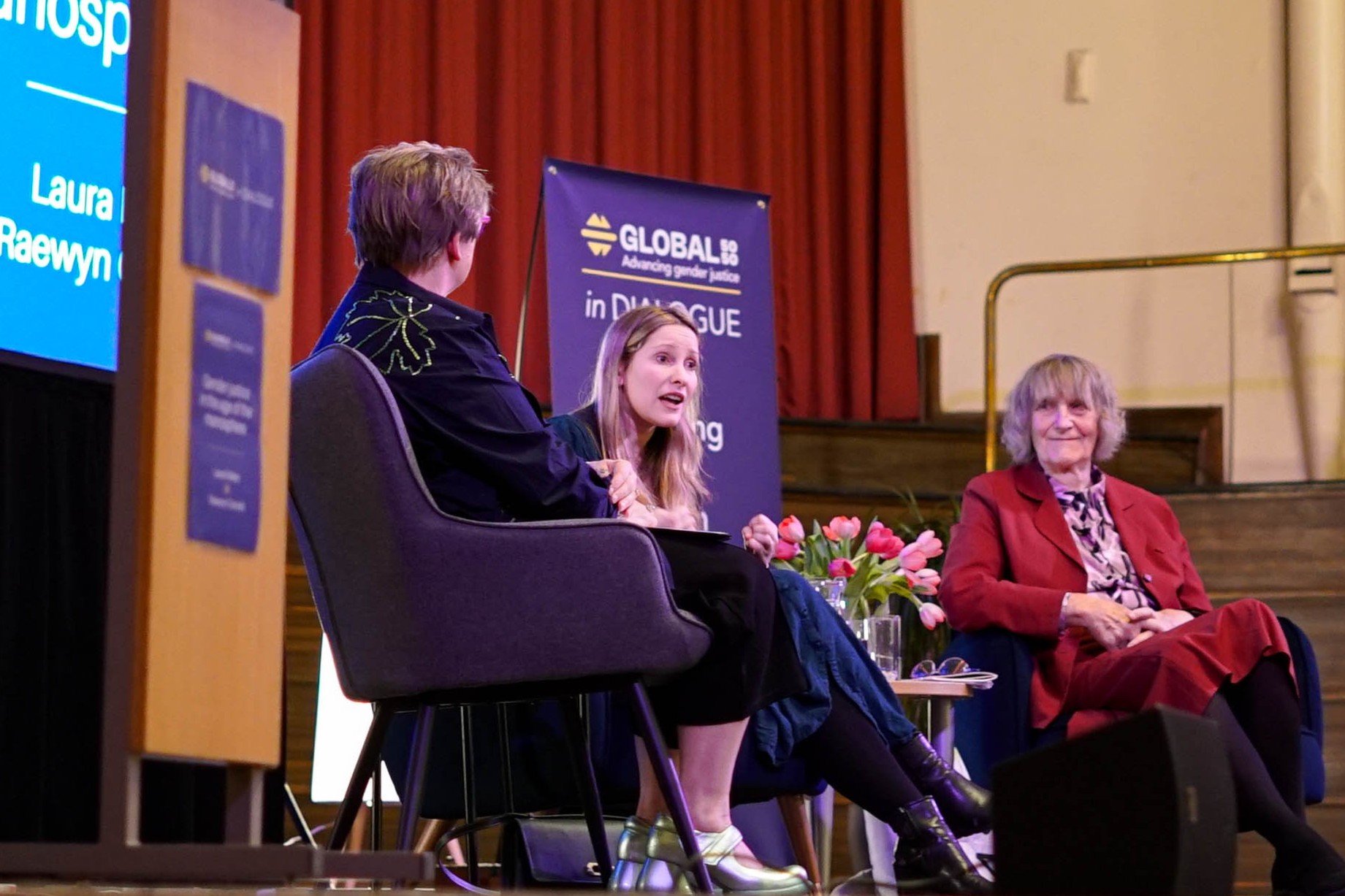
Laura Bates and Raewyn Connell in conversation as part of our In Dialogue series
Why removing harmful posts alone will not stop the spread of online misogyny, and what governments should do instead.
What a public health response to the manosphere involves
Public health approaches have been used to address other complex and contested harms, including gender-based violence and drug use. They do this by targeting underlying social, structural and commercial determinants; reducing stigma and discrimination; reframing public narratives and attitudes; expanding equitable access to services; and moving beyond the carceral logic of policing and punishment as the primary responses.
A public health response addresses upstream determinants and combines population-level prevention, education and engagement, norm change, and the strengthening of health and social systems alongside regulatory and fiscal measures. The Viewpoint proposes six priorities, summarised below.
This is a political, legal, economic and social challenge demanding coordinated, sustained action on multiple fronts, and a public health framing can unlock such an approach.

The manosphere did not invent misogyny, but it is amplifying it. It thrives in political conditions that a wider, well-resourced opposition to gender justice helps to sustain, which is why the Viewpoint ends by calling for those movements to be confronted. The Organised Many sets out how the movement can respond.

Professor of Global Public Health and Co-CEO, Global 50/50
Professor of Health Policy and Co-CEO, Global 50/50