Naila Kabeer, Emeritus Professor of Gender and Development, London School of Economics and Political Science
In villages across India, community organisations sent trained investigators to do what the state had failed to do: find mothers whose deaths had gone unrecorded, and write their names down. This act of counting was not just a technical exercise, it was an act of recognition and resistance.
Between 2012 and 2013, across ten states of India, twenty-two community-based and civil society organisations set themselves a strange and difficult task. Their investigators walked to villages that formal health services rarely reached, looking for a particular category of women who had died – those who had died in pregnancy or childbirth and whose deaths had gone unrecorded, as though they had never happened. The initiative had a blunt, unforgettable name: Dead Women Talking.
They were up against more than distance. Fewer than half of maternal deaths in India were entering the official record, by the government’s own estimate, and some of the people meant to record them did not want to: front-line health workers were reluctant even to speak about a death, the initiative found, in a system where blame settles on the lowest rung of the hierarchy. Thus, a woman could die in childbirth and then disappear a second time, out of the figures that decide where money and midwives are allocated; on paper, her village looks like one with little need. The investigators of Dead Women Talking were determined to make her count: 124 women in the thirty-one districts where they worked, most of them from the country’s most marginalised communities, restored name by name to a record that had missed them. A companion project in Gujarat, run from 2013 to 2017 by one of the participating organisations, suggests that reporting of maternal deaths improved where women’s community-based organisations were active.
It is tempting to treat this as a problem of weak record-keeping in the global South. It is not. The failure to count women is not a gap at the edges of the system. It is built into the foundations, and it appears just as clearly in the richest institutions in the world.
Consider one of the largest numbers in economics. Every day, people do around 16.4 billion hours of unpaid care work: cooking, cleaning, raising children, tending the sick and the old. Valued at even the minimum wage it would be worth some US$11 trillion, close to a tenth of the entire global economy, and women do more than three-quarters of it. Almost none of it shows up in any measure of what the world produces. When governments calculate GDP, the number that shapes budgets, markets and elections, they draw a line around what counts as “the economy”, and unpaid work falls outside it by design. The economist Marilyn Waring showed decades ago exactly what that line does: it records a woman’s day of labour as worth nothing at all. The single largest form of work on earth, the work that reproduces the labour that produces the GDP, is statistically invisible.
The same pattern holds in medicine, where the cost is measured in lives. For most of its modern history, the body that clinical research studied was male. Basic research was often assumed to be possible only on male bodies, with female bodies seen as the exception. Some of this was belief and some was simple failure to look: a research culture that took the male body as the default and treated the question as settled. After the thalidomide tragedy the US regulator went so far, in 1977, as to recommend keeping women “of childbearing potential” out of early drug trials, a rule applied so broadly that it kept most women out of research for sixteen years; not until 1993 did American law require their inclusion in publicly funded research. Heart disease, for example, was studied as a man’s illness, so the different way it presents in women went largely unexamined. The doses, the warning signs, the readings called “normal” were calibrated to a body that was not female, and then handed to them as though it were. And the blind spot is now being wired into the future, as diagnostic algorithms trained mostly on male data threaten to automate the old bias at scale.
The United Nations has known all of this for decades: the uncounted deaths, the invisible labour, the women missing from the data. It has committed repeatedly to count.
In 1995 the Beijing Platform for Action named sex-disaggregated data a strategic objective. In 2015 all UN member states signed up to the Sustainable Development Goals. Goal 17.18 is a commitment to ensure data is broken down by multiple variables, including sex, age, income and disability, with a deadline of 2020. The cost of doing without it was already on the record. When Ebola tore through West Africa in 2014, responders could not say clearly who was dying, or why, because the data was not reported by sex; a review of the literature found only patchy sex-disaggregated reporting across outbreaks dating back to 1976. The lesson went unlearned.
The deadline was 2020, the year Covid-19 arrived. The system could not do what it had promised to do five years earlier. Global 50/50 built the world’s Sex, Gender and Covid-19 Data Tracker for a simple reason: no one else was bringing together sex-disaggregated data on vaccination, testing, hospitalisation, ICU occupancy and death. At its peak, barely more than half of the 187 countries tracked, 54%, were publishing any sex-disaggregated data on cases or deaths in a given month. A five-year promise, tested by the first global emergency to follow it, delivered a world that could not work out whether the crisis was affecting men and women differently.
What makes this failure hard to excuse is that so much of the machinery already exists. The UN’s own Statistical Commission has agreed a Minimum Set of Gender Indicators. Seventy-five UN entities, 96% of the system, already report annually under its System-Wide Action Plan on gender equality. Thus the standard exists, processes are in place, and agencies have shown they can deliver on it. What is missing is not a principle but the insistence that it be met, everywhere, by default rather than by exception. That insistence is what the Global 50/50’s open letter asks of the next Secretary-General to act on, and it is why I have added my name to it.
It is worth being clear about what counting actually is, because it is easy to mistake it for bureaucracy. The investigators who walked those villages were not doing paperwork. They were performing an act of recognition, insisting that a woman who had died existed, and mattered, and belonged in the record that decides what happens next. To count someone is to affirm their intrinsic worth, and to accept that they are owed something. That is why the failure to count is never just an accident, and why the struggle to be counted is never really just about data. It is a struggle for recognition for those whose lives are invisible, and whose claims go unacknowledged.
In villages across ten states in India, communities organised to insist that the mothers who died would be seen. The United Nations with the whole world’s data at its command can decide the same thing, and practice it everywhere.
We keep learning the same lesson because we keep declining to act on it. The next crisis is already on its way, as the last one always was. The question is whether, now, we will have decided in advance to count everyone it reaches.
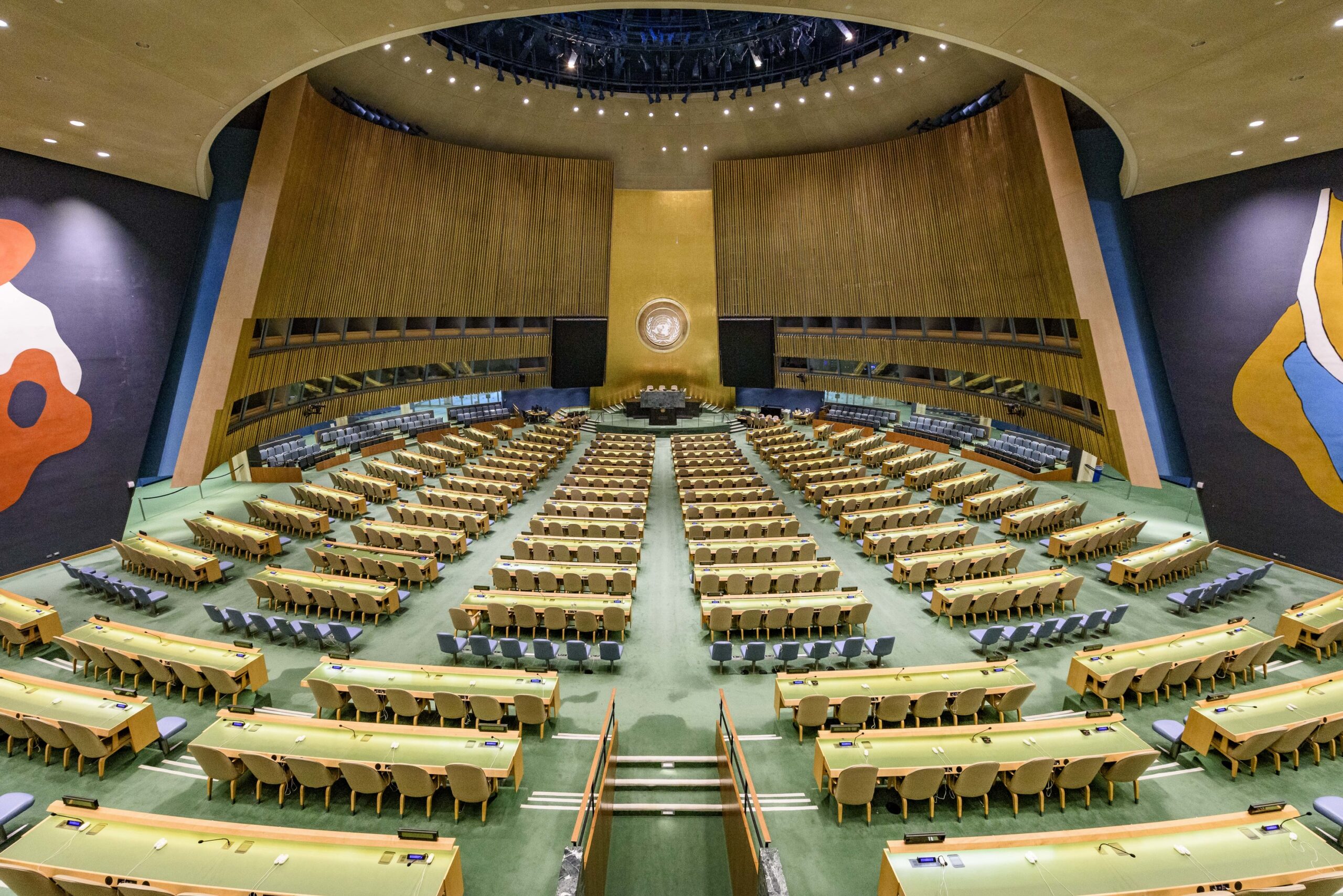
Join the call
‘Measure it’ is the first of five commitments in the open letter to the next UN Secretary-General. Hundreds of individuals and organisations have signed.