
Global justice 50/50 research framework & methods
Image: Reclaim the night, Sudip Maiti (India)
We review the gender-related policies and practices of 171 global organisations active in the global law and justice sector. This page presents an overview of the research framework, sampling framework, and data collection and validation methods.
For more detailed information on our methods, see Annex 3 of the 2026 Global Justice 50/50 Report.
Global Justice 50/50 Variables
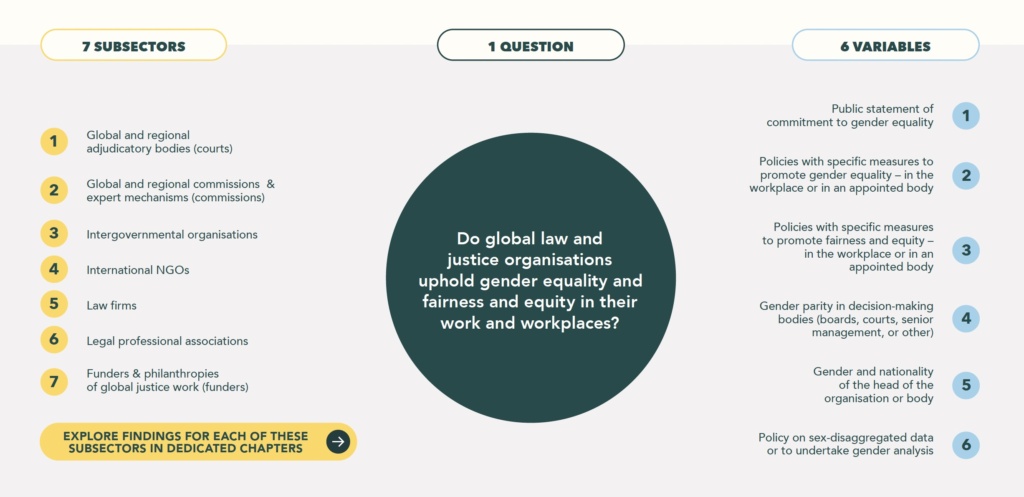
Through an examination of six variables, the Global Justice 50/50 Report provides an in-depth look at the extent to which global organisations from seven subsectors have commitments and policies to promote gender equality and other aspects of fairness and equity, and who gains access to positions of power within organisations.
The detailed scoring key for each of the variables is available here.
Expand to read more
Global 50/50 defines ‘global organisations’ as those with a presence in at least three countries. The sample includes organisations that traditionally uphold the rule of law and those organisations which perform a function of promoting and/or safeguarding access to justice in the wider sense.
For the purposes of the Global Justice 50/50 Report, the justice sector is defined as the set of institutions that are responsible for ensuring that legal rights of individuals and groups are protected, resolving conflicts arising from alleged violations or differing interpretations of laws and rules, and strengthening the normative framework that shapes public and private actions (1). Key components of the justice sector include judicial or adjudicatory bodies (e.g., courts, tribunals) responsible for interpreting laws and adjudicating disputes. Additionally, nongovernmental components of the justice sector may include alternative dispute mechanisms (e.g., private arbitral tribunals, community-based resolution mechanisms).
The law sector is defined as focusing on the creation, interpretation, application, and enforcement of laws, regulations, and legal frameworks within a society or jurisdiction. Key components include legislative bodies (e.g. United Nations General Assembly, European Parliament, ministries of justice), regulatory or administrative bodies that facilitate interpretation and implementation of laws (e.g. treaty monitoring bodies), and prosecutorial bodies involved with enforcement. Additionally, nongovernmental components of the law sector include legal practitioners (e.g. private law firms, chambers) who apply these laws and nongovernmental organisations who advocate for changes in the law (2).
In developing the sampling framework for this Report, G5050 commissioned consultants to map the global law and justice sector and propose approaches for selecting representative organisations across global, regional, and, where relevant, national levels. An options paper identifying key subsectors for inclusion and exploring different sampling approaches was circulated to experts across the sector, inviting feedback through an accompanying survey.
The 2026 sample includes:
- 22 global and regional adjudicatory bodies
- 19 global and regional commissions and expert mechanisms (commissions)
- 11 intergovernmental organisations with a mandate for justice / rights
- 51 international non-governmental organisations working in the justice / rights space
- 38 law firms
- 11 bar associations
- 19 funders and philanthropies that support gender justice in the justice sector
Inclusion of an organisation does not signify G5050’s endorsement of its activities, nor that G5050 considers the organisation to be contributing to advancing legal discourse in a positive direction. Rather, organisations under review have been identified as having demonstrated an interest in influencing global legal rules, norms, or frameworks.
We recognise the limitations of grouping organisations by sector, particularly in light of the unique features of many in our sample that preclude distinct categorisation. We have sought to establish clear rationale for the categorisation of each organisation.
Approach and methods for data collection and validation
Expand to read more
G5050 has developed a rigorous methodology that is consistent with established systematic review research methods. At least two reviewers extract each publicly available data item independently, and a third reviewer verifies the data. The reviewers discuss any discrepancies in data extraction until they reach a consensus. Data are coded according to content, using a traffic light system established in advance of data collection and refined iteratively.
Data collected and analysed come from publicly available websites. Transparency and accountability are closely related and by relying on publicly available data we aim to hold organisations and stakeholders to account – including for having gender-related policies accessible to the public.
We used an earlier version of this methodology to review a small number of global health organisations and global PPPs in health. These reviews were published in peer-reviewed journals (The Lancet and Globalization and Health) prior to 2017.
Engaging and validating results with organisations
Expand to read more
We contact each organisation at least twice during data validation. Initially we inform the head of the organisation and a senior member of staff about the project and the start date of data collection, using email addresses found online. In that correspondence, we request the nomination and contact details of a focal point in the organisation who can review and validate the data once collected. Following completion of data collection, we send each organisation their preliminary results and ask them to review and provide any additional information, documentation or policies to review.
We also offer all organisations the opportunity to engage with us directly to discuss the methods, data, and findings. Throughout the process of data collection, G5050 encourages organisations to contact us to discuss queries about the process and the variables. Results are shared with all organisations before publication.
Data were collected between 12 February and 23 May 2025; data validation with organisations took place between the 9 June 2025 and 30 July 2025.
Ethics
The methods described above have been approved by the ethics committee of University College London, where Global 50/50 (formerly Global Health 50/50) was previously housed and have been reviewed by the Social Research Association (UK).
Strengths and limitations
Expand to read more
As far as we know, this is the only systematic attempt to assess how gender is understood and practised by organisations working in and/or influencing the field of global law and justice across multiple dimensions (commitment, workplace policy content, gender and geography of leadership and gender-responsive programming). While our efforts may have omitted relevant measures and do not include all active organisations, this method provides the opportunity to measure the status quo and report on organisations’ progress. This method has previously allowed us to shine a light on the state of gender equality in the global health sector, and we now bring this proven approach to this new sector. We believe that the collection of data and information for measurement and accountability is a fundamental first step to change.