
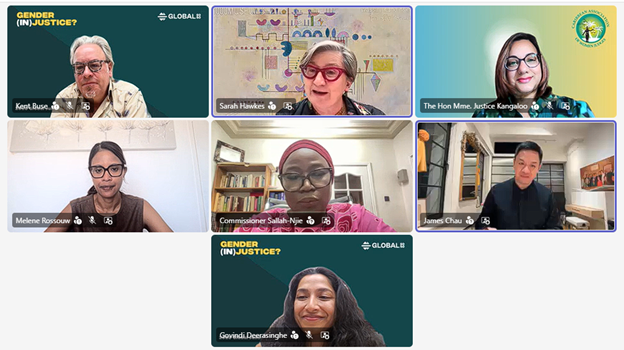
WATCH: Gender, power & the justice institutions that shape our lives
“When you see yourself in a person sitting on the bench, it resonates with how you understand and perceive justice and how you experience it. As institutional leaders, we have to propel ourselves beyond the thresholds of our colonial history, hierarchical structures, cultural norms. And that’s what this report invites us to do.”
To mark the launch of Gender (In)Justice?, our inaugural Global Justice 50/50 report, we convened a global audience for a discussion on gender, power, and accountability across the law and justice sector.
The conversation featured:
- Hon. Commissioner Janet Ramatoulie Sallah-Njie, Vice Chair of the African Commission on Human and Peoples’ Rights and Special Rapporteur on the Rights of Women in Africa; Global Justice 50/50 Advisor.
- Hon. Justice Nadia Kangaloo, High Court Judge in the Judiciary of the Republic of Trinidad and Tobago and President of the Caribbean Association of Women Judges.
- Melene Rossouw, LLM, Founder of Women Lead Movement and admitted attorney of the High Court of South Africa, Global Justice 50/50 Advisor.
- James Chau, Moderator and President of the China-United States Exchange Foundation; Global Health 50/50 Advisor.
- Govindi Deerasinghe LLM. Justice Lead at Global 50/50.
- Prof Sarah Hawkes and Prof Kent Buse, Co-founders and Co-CEOs of Global 50/50.
For those who missed the live event — or want to revisit the conversation — the full recording is available to watch below.
Summary
James Chau opened the discussion with an uncomfortable question:
“Who decides what justice looks like — and for whom?”
He highlighted the urgency of this question: courts are increasingly politicised, access to justice is narrowing, and public trust in institutions meant to uphold rights is fraying, all while a global backlash against gender equality and women’s rights gains momentum. Now more than ever, understanding who holds power in justice institutions is crucial. The Global Justice 50/50 inaugural report holds up a mirror to the sector, offering a clear, measurable picture of power, policy and the state of gender equality across justice institutions worldwide.
Govindi Deerasinghe presented headline findings from the report’s assessment of the policies, practices, and leadership of 171 global law and justice institutions. Using Global 50/50’s established evidence-driven methodology, the analysis provides one of the first systematic snapshots of who holds power across the justice ecosystem — and how institutions measure up on gender equality.
Perspectives from leaders across the justice sector
The panel reflected on the implications of the Global Justice 50/50 report for gender equality and leadership across global justice institutions.
Janet Ramatoulie Sallah-Njie highlighted the report’s exposure of deep imbalances – gendered and geographic – in global justice leadership. The report, she argued, demands moving from aspiration to obligation: embedding mandatory gender parity targets tied to appointments, funding, and accountability, and making gender equality a governance requirement rather than a moral appeal.
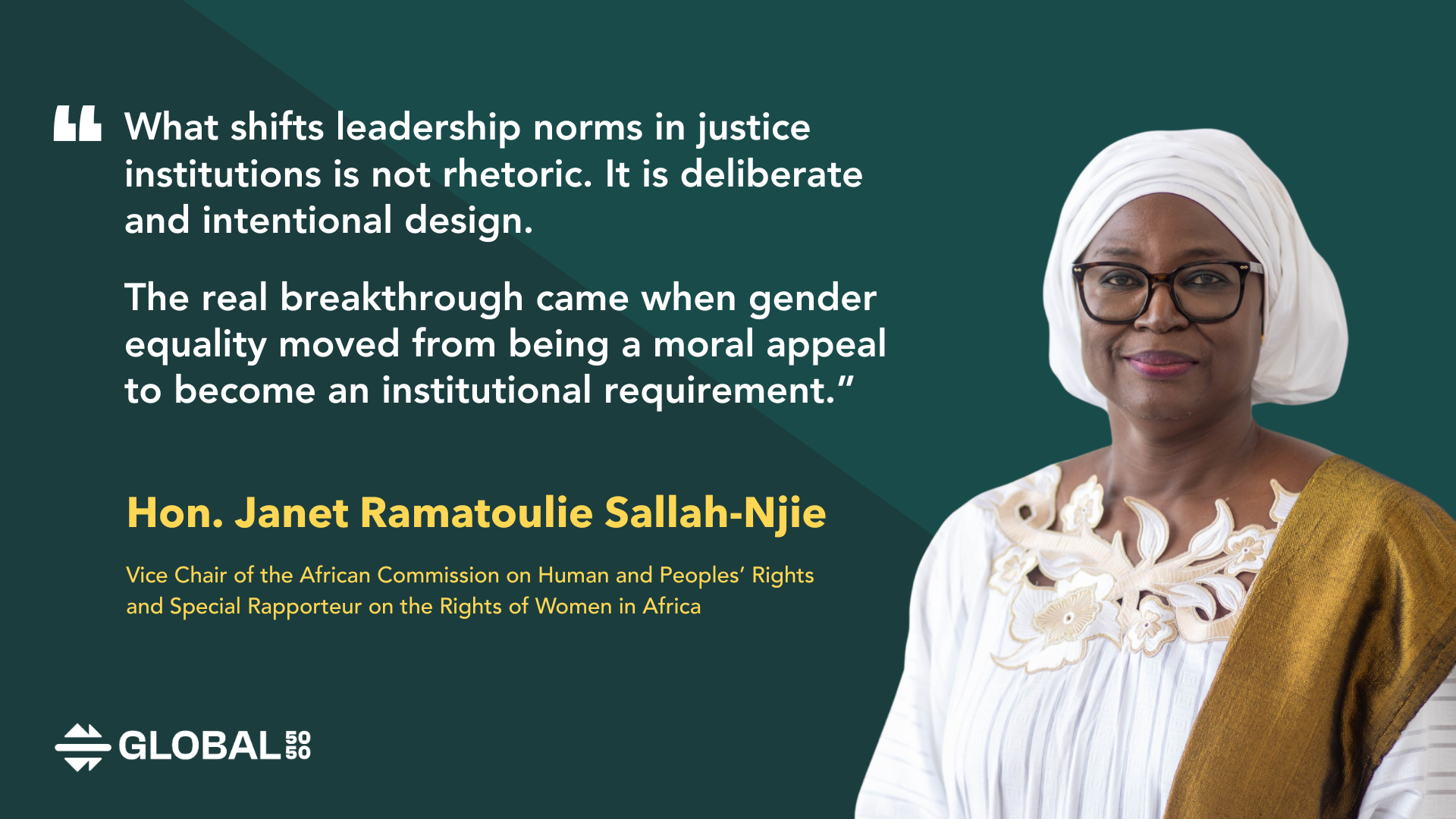
Justice Nadia Kangaloo described the report as both sobering and affirming of her own experience. She emphasised that the report pushes institutions beyond counting women toward examining how power is exercised. Bolstered by the findings of the report, she called for systemic reform – embedding support, respectful culture, and structural change within judicial institutions so that women can exercise meaningful authority and thrive.
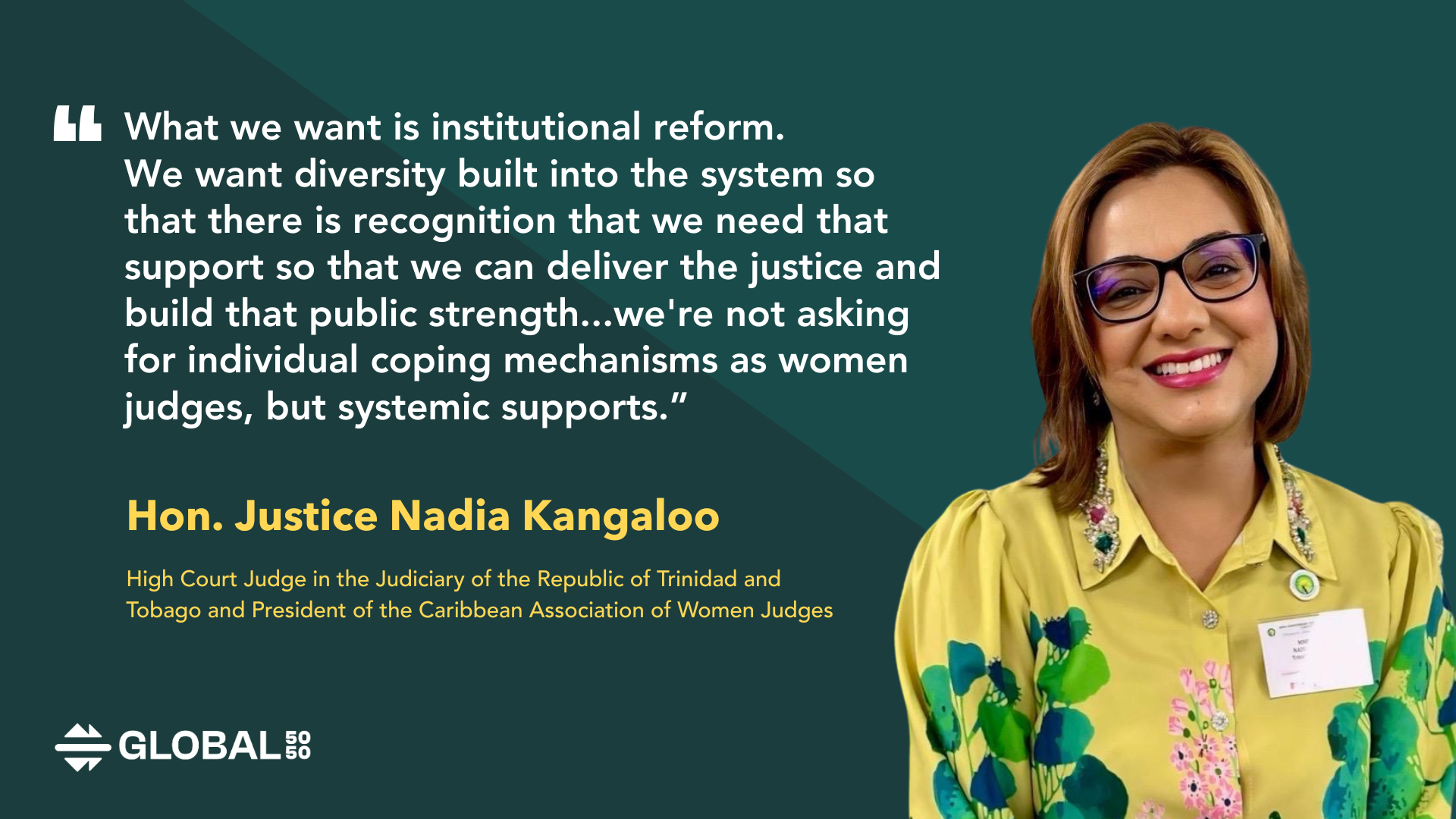
Melene Rossouw asserted that the value of the report lies in its data-driven evidence, which civil society can use to hold institutions accountable. She urged funders to use the report to embed equity requirements into funding criteria and encouraged civil society to maintain pressure through advocacy, monitoring, and, where necessary, litigation to drive structural change.
!["Representation is mistaken for transformation. Some institutions assume that because they have women in leadership, that that automatically equates to progress. Presence is not power. What we do need is those women in leadership to actually have control over resources, how [those] resources are spent, where it's spent, when it's spent. They must have the ability to influence the agenda, influence how the agenda is set and how that agenda is being driven. And of course, most importantly, they must influence decision making within that institution.” – Melene Rossouw, LLM, Founder of Women Lead Movement and admitted attorney of the High Court of South Africa](https://global5050.org/wp-content/uploads/2026/02/Melene_Quote_GJ5050_Webinar-1.png)
The conversation made clear that advancing gender equality in justice institutions is not about symbolic representation. Achieving this requires deliberate, structural change, transparency, and accountability – and a commitment to creating cultures that empower women leaders and reinforce public trust in justice. The Global Justice 50/50 Report, Gender (In)Justice, provides the evidence and insights needed to drive this change – read it to understand the challenges, see who holds power, and begin taking action.
Explore the data
Read the reportGender & Justice IndexLeadership in Law & Justice Dashboard
Take action
Workplace policy repositoryTools for organisational change