
Raising the Bar: What the IBA’s Phase 2 findings show—and what must change
On 12 March 2026, Global 50/50 joined the International Bar Association’s (IBA) London launch of Raising the Bar: Women in Law Phase 2 report, a moment that brought to the fore the lived experiences of women across the global legal profession and the policy levers that can meaningfully shift systems. Respondents from more than 100 jurisdictions shared experiences that mirror what our Gender (In)Justice? report makes evident: the legal profession continues to rely on systems that are opaque, inconsistent, and largely unaccountable, and women’s experiences in these workplaces reflect the consequences. These are not neutral features of the system; they are design choices that distribute opportunity unevenly and allow organisations to signal commitment without being held accountable for results.
Inside the event: leadership insights and system-level realities
Following opening remarks from IBA President Claudio Visco, Immediate Past President Almudena Arpón de Mendívil, and Secretary-General Deborah Enix-Ross, Director of the IBA Legal Policy & Research Unit Sara Carnegie presented the Phase 2 findings, emphasising priority recommendations such as embedding flexible work, improving transparency around workplace initiatives, and strengthening wellbeing and safeguarding systems, underscoring that meaningful progress requires system‑level redesign rather than incremental adjustments.
The Inspiring Leaders panel discussed the realities of navigating a profession shaped by informal norms and opaque advancement systems:
- Claire Keast-Butler, Co-Managing Partner of Cooley’s London office, reflected on her career journey and the women who supported her, underscoring the importance of networks and of ensuring younger women encounter fewer barriers than those who came before them.
- Samantha Rowe, Partner at Debevoise & Plimpton, contrasted her early career in New York, where meritocracy felt more overt, with the more conservative cultures she later encountered, reinforcing that systems, not talent, determine who progresses.
- Sarah Goom, Director General of the UK Government Legal Department’s Commercial with Trade and International Group, articulated a key distinction in how opportunity is allocated: “Mentors talk with you; sponsors talk about you in spaces you can’t access.”
- Christina Blacklaws, former President of the Law Society of England and Wales, encouraged women to be less apologetic, highlighting the behavioural norms that still shape expectation across the sector.
The discussion continued with the Change Makers panel, which explored the institutional design choices behind these experiences:
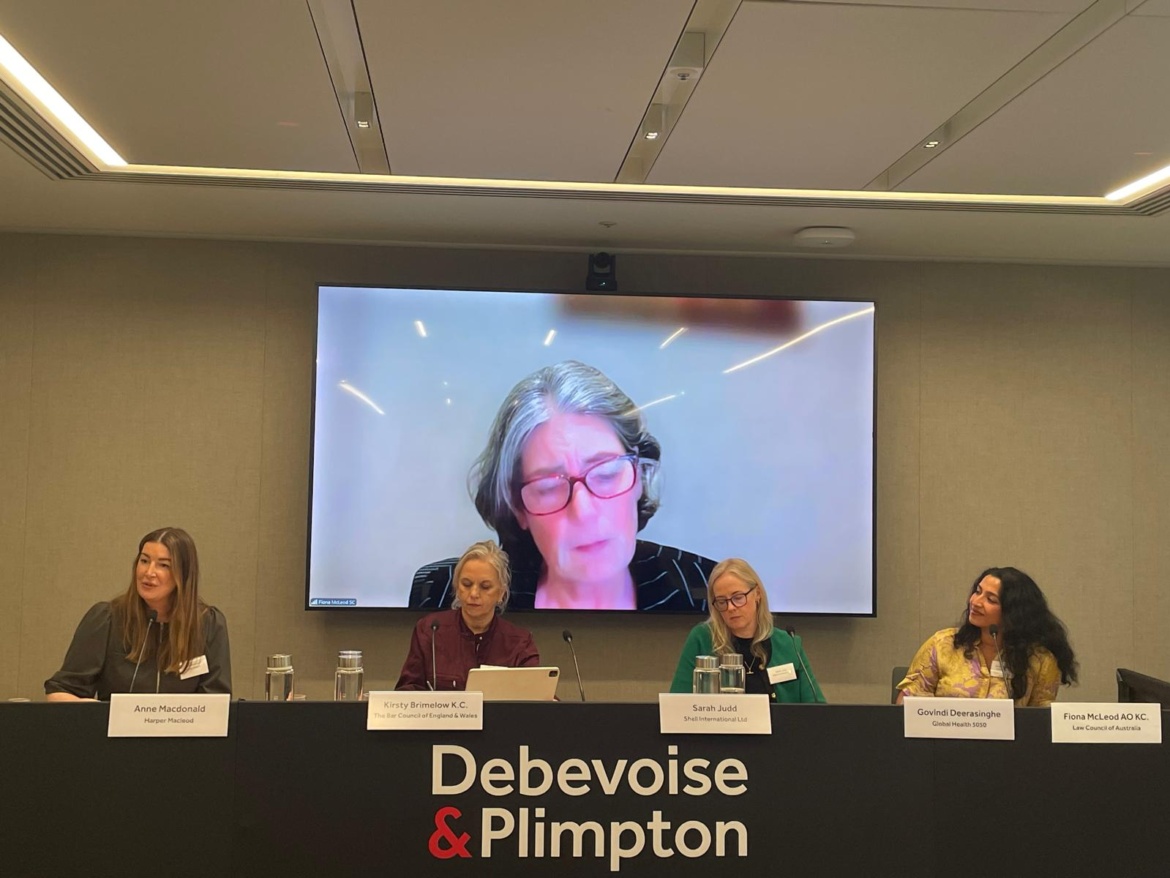
- Anne Macdonald, Partner at Harper Macleod LLP and Chair of the IBA Law Firm Management Committee, emphasised that cultural change, especially around work allocation, leadership behaviours, and everyday interactions, must accompany structural reforms to ensure progress endures.
- Kirsty Brimelow KC, Chair of the Bar Council of England & Wales, highlighted the continuing income gap at the Bar and pointed to the findings of the Harman Review – which exposed system bullying and sexual harassment and set out 36 recommendations to address them – as evidence that meaningful progress requires both transparency and formal accountability mechanisms.
- Sarah Judd, Vice President and Associate General Counsel, ESG, Global at Shell International Limited reminded the room that not every phase requires acceleration, that it is legitimate to move between work mode and career mode, and organisations should make space for this without penalty.
- Govindi Deerasinghe, Justice Lead at Global 50/50, stressed the need to broaden conversations about gender equality beyond numerical parity to include principles of feminist leadership.
Moderator Fiona McLeod AO SC, former President of the Law Council of Australia, spoke to the importance of redesigning systems, not simply encouraging women to adapt to them, with one of the panel’s most memorable lines: “We are here to shine. Bring us on board, or step aside.”
While the event created space for valuable discussion, it also highlighted gaps, including limited racial and ethnic diversity in the room. Future reform efforts must centre a broader range of experiences, particularly those of individuals who remain systematically excluded, if the profession’s vision of equality is to be shaped by the people it aims to serve.
What emerged clearly from these discussions is not only the persistence of inequality, but the limits of current approaches to addressing it.
What the IBA surfaced, and what G5050’s evidence explains
Across 4,933 women lawyers surveyed by the IBA, reports widely differed on access to the most impactful initiatives: flexible work (available to 59%), mentoring (40%), leadership training (20%), carers’ support (14%), and menopause/perimenopause support (5%). Meanwhile, hostile workplace culture (50%), mental/physical health (49%), discrimination (24%), and work-life balance (24%) remain leading reasons why women leave the profession.
These findings complement what G5050 quantifies at organisational level:
- 54% of 171 organisations across the global law and justice system publicly commit to gender equality, but far fewer publish specific, enforceable measures
- Only 44% have publicly available gender quality policies with specific measures; 41% publish broader fairness and equality policies
- Fewer than one-fifth of organisations commit to regularly collecting or reporting sex-disaggregated programmatic data or undertaking gender analysis
- Women hold 40% of top roles, but women from low-incomes countries hold under 1%
Where much of the field, including IBA, focuses on experiences and initiatives, Global 50/50 focuses on the rules, incentives, and accountability structures that shape them. This allows us to move beyond describing inequality to identifying what organisations must change to produce different outcomes.
Why this matters beyond the profession
The legal profession shapes the rules, systems, and rights on which societies depend. When gender equality falters here, its effects extend far beyond courts, firms and chambers.
The World Bank’s Women, Business and the Law 2026 report shows that fewer than 5% of women globally live in economies close to full legal equality, with average report index scores of 67/100 for laws supporting women’s economic equality, 53/100 for enforcement, and 47/100 for supportive systems. Crucially, stronger equality laws are associated with higher female and male labour force participation, narrower gender gaps, more entrepreneurship, and greater political representation. Each one-point improvement in legal equality corresponds to a 0.60-point increase in women’s labour force participation.
Gender justice in the law and justice sector is therefore not only a matter of fairness, it directly affects economic performance, institutional integrity, and inclusive governance.
Resources to support action
To help organisations translate commitments into concrete change, G5050 provides:
- The G5050 Resource Bank – practical tools, how‑to guides, and guidance and research from a range of organisations designed to support building workplaces that are fair, equitable, and guided by feminist leadership principles.
- The Workplace Policy Repository (Law & Justice) – a curated library of publicly available policies that demonstrate best practice from organisations across the global law and justice sector.
Where we go from here
The IBA report launch underscored both the urgency and willingness of the profession to act. Further to the launch of Gender (In)Justice? in February 2026, G5050 is now beginning a process to co-develop a shared, evidence-based reform agenda with partners across the legal ecosystem. We welcome collaboration with practitioners, regulators, policy makers, professional networks, funders, and civil society groups committed to strengthening accountability and transparency in the profession.
We invite partners to contact us to work together on:
- shifting from voluntary commitments to enforceable minimum standards strengthening criteria‑based pathways to leadership, including sponsorship models
- building independent reporting and safeguarding systems
- expanding use of sex‑disaggregated data for decision‑making and transparency
- embedding flexible work, wellbeing, and life‑stage support
- widening global representation, especially for women from under‑represented backgrounds and regions
These priorities reflect Global 50/50’s frameworks while leaving space for collaborators – including many of those who present at the IBA launch and involved in the development of the report – to shape and lead the next phase of reform.
Organisations and individuals interested in partnering with us to co‑develop recommendations or pilot reforms are warmly encouraged to get in touch at info@global5050.org