
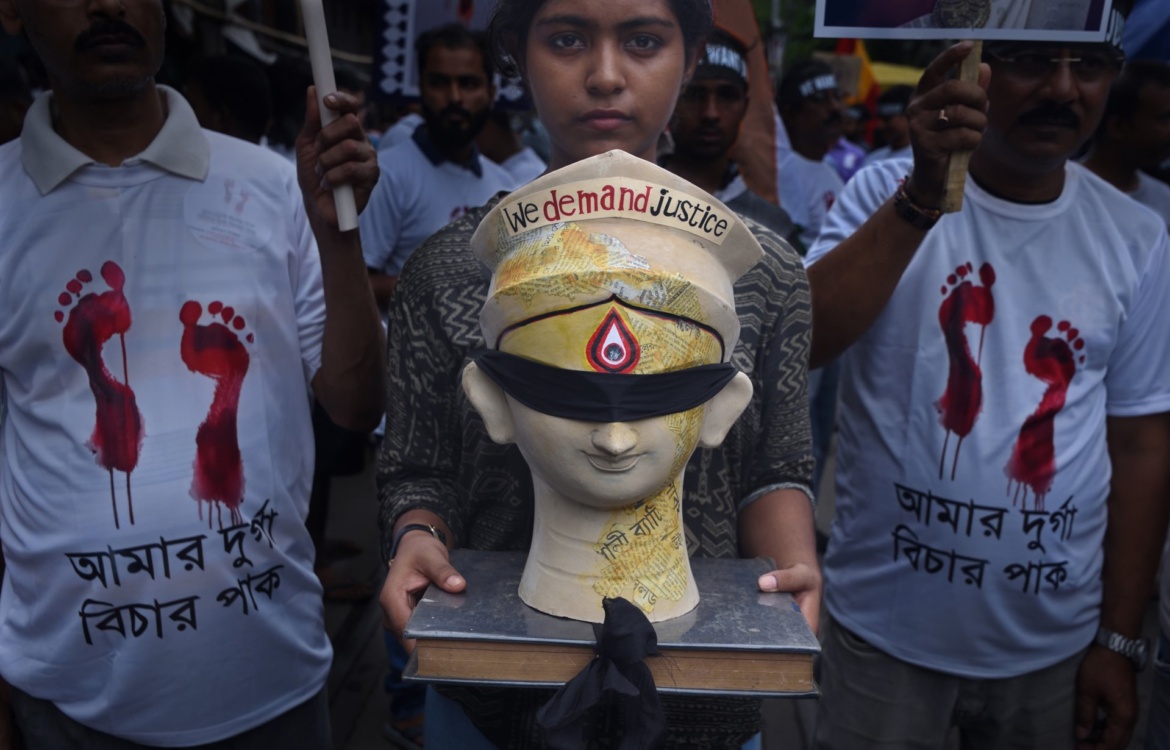
World Day for International Justice 2026: The law is not neutral. It never has been.
Dr A.H. Monjurul Kabir, UN Women Country Representative in Liberia, traces the gap between formal legal equality and lived justice – from who holds power at the top of global law and justice institutions, to how artificial intelligence risks encoding their historic blind spots at scale, to the question every institution serious about change should be sitting with: who are we not seeing, and what does that cost them?
The law is not neutral. It never has been. It was written by particular people, in particular places, to serve certain interests, and then described as universal. Global Justice 50/50’s inaugural report – Gender (In)Justice? – is the first independent, systematic assessment of gender equality, fairness and equity across 171 organisations active in global law and justice. It puts one question to all of them: how much has that changed? The honest answer is that the progress is real, but it has not reached the top, and the top is where it matters most.
Half of the 171 organisations the report covers have made a public commitment to gender equality. Women hold 43% of senior roles, closer to parity than most people would expect. But look at who holds the most senior individual positions – the presidents of global and regional courts, the heads of international tribunals, the managing partners of elite law firms -and the picture narrows sharply. Men hold 71% of those top seats in courts and 80% in the most powerful international law firms. More than half of the 302 most senior offices across the report are held by nationals of just two countries: the United States and the United Kingdom.
This is not incidental. It is structural. The sector has opened doors for women in its middle tiers, while the positions at the very top, which is where law is often made, precedents are set and institutional direction is decided, remain predominantly male.
The measurement problem
Counting women in institutions matters because you cannot change what you cannot see. But counting can become a substitute for the harder work. A 43% aggregate tells you women are present. It does not tell you which women, from where, in what roles, with what power to shape outcomes that affect people very different from themselves.
An intersectional approach insists on that harder question. Not only “how many women?” but “which women?” and, more uncomfortably, “women as defined by whom?” Disability, race, ethnicity, class, geography: these are not add-ons to the gender analysis. They are the analysis. Fewer than one in five organisations in the report are committed to understanding who is, and who is not, being served by their work. That is not an oversight. It is a choice about which questions an institution is willing to ask.
I have worked on governance, development, rule of law, human rights and gender equality in multilateral institutions for over two decades. The gap between commitment and delivery is not a mystery. It persists because delivery requires changing the architecture the structures, the incentives, the informal hierarchies- not just the stated position. Commitment is relatively costless, and turning it into policy costs more, but the work most institutions never finish is the practice that changes not just who is present but who the system is for.
The “legitimacy” question
The concentration of global legal leadership in the hands of a narrow geography is not only an equity problem. It is a legitimacy problem. International law claims to speak for humanity. But fewer than 1% of the highest offices studied are held by women from low-income countries. The Global Majority, whose populations make up most of the world, and whose people most frequently encounter justice institutions as subjects rather than architects, are largely absent from the rooms where the rules are written.
This matters beyond symbolism. The report’s evidence shows that gender-diverse tribunals, particularly those with women investigators, prosecutors and judges, are more likely to pursue cases of sexual and gender-based violence and to engage survivors with sensitivity. Diversity changes outcomes, not just optics. But diversity of gender without diversity of origin, class and experience produces a narrower kind of change than the architecture demands.
Let us also not forget that parity at the aggregate can mask who is still missing. An intersectional approach would help us more in breaking down segmented, siloed, often discriminatory approach to development. It can go a long way towards addressing these inequalities. With growing recognition that failure to address complex social systems and identities can obscure or deny the human rights protections due to all, it is crucial to design programmes and policies that effectively address not only discrimination based on ethnicity, disability, or religion but the situation of those affected by all forms of compounded and intersecting forms of discrimination.
The window we are about to close
Artificial intelligence is reshaping the sector faster than most of its institutions are ready for. Algorithms are being used to assess risk, analyse evidence, and support decisions that determine who is charged, who is convicted, who is freed. These tools encode their training data. Their training data encodes the past. And the report’s own data makes the nature of that past plain: 81% of the highest offices held by nationals of high-income countries, fewer than 1% by women from low-income countries, gender equality commitments more common on paper than in practice. AI does not inherit that history neutrally. It entrenches it.
If the sector arrives at this transition still concentrating its highest offices in the hands of nationals from two countries, still treating intersectionality as optional, still living with the gap between commitment and practice, it will encode all of that. Not metaphorically, but literally, in the systems that will shape justice for the next generation.
The window to get this right is open, but it will not stay open indefinitely.
The road from here
The Gender (In)Justice? report is not pessimistic. Its evidence shows what changes when institutions commit seriously: more cases pursued, more survivors heard, more communities reached. The organisations closing the gap between commitment and delivery are the ones that have stopped asking “do we believe in gender equality?” and started asking “who are we not seeing, and what does that cost them?”
That is, at its core, an intersectional question. It is also, simply, a justice question. And for institutions whose entire purpose is justice, it is the only one worth asking.