
WATCH: Whose justice? Gender and power in South Asia’s legal institutions
“Institutions of justice must demonstrate that they themselves are just and equitable within.”
Six months after publishing Gender (In)Justice?, our inaugural Global Justice 50/50 report, we convened an audience across South Asia and beyond with the Asia Justice Coalition to ask what the findings look like from inside the region’s legal institutions.
The conversation featured:
- Prof Margaret Satterthwaite, United Nations Special Rapporteur on the independence of judges and lawyers; Professor of Law, NYU School of Law.
- Ms Maja Daruwala, Convenor and Chief Editor of the India Justice Report; Barrister of Lincoln’s Inn.
- Dr Faustina Pereira, Professor, School of General Education, and Senior Fellow, Centre for Peace and Justice, BRAC University.
- Justice Kumudini Wickremasinghe, retired Justice of the Supreme Court of Sri Lanka and Inaugural President of the Sri Lanka Association of Women Judges.
- Dr Priya Pillai, Executive Director, Asia Justice Coalition.
- Sonja Tanaka MPH, Moderator and Director of Programmes and Innovation, Global 50/50.
- Govindi Deerasinghe LLM, Justice Lead, Global 50/50.
- Prof Sarah Hawkes, Co-CEO and Co-Founder, Global 50/50.
For those who missed the live event — or want to revisit the conversation — the full recording is available to watch below.
Summary
Sonja Tanaka opened by asking who holds power in the institutions that decide what justice looks like, and for whom. Courts, commissions and professional bodies decide whether a woman can leave a violent marriage, whether a worker can challenge an employer, whether a community holds on to its land.
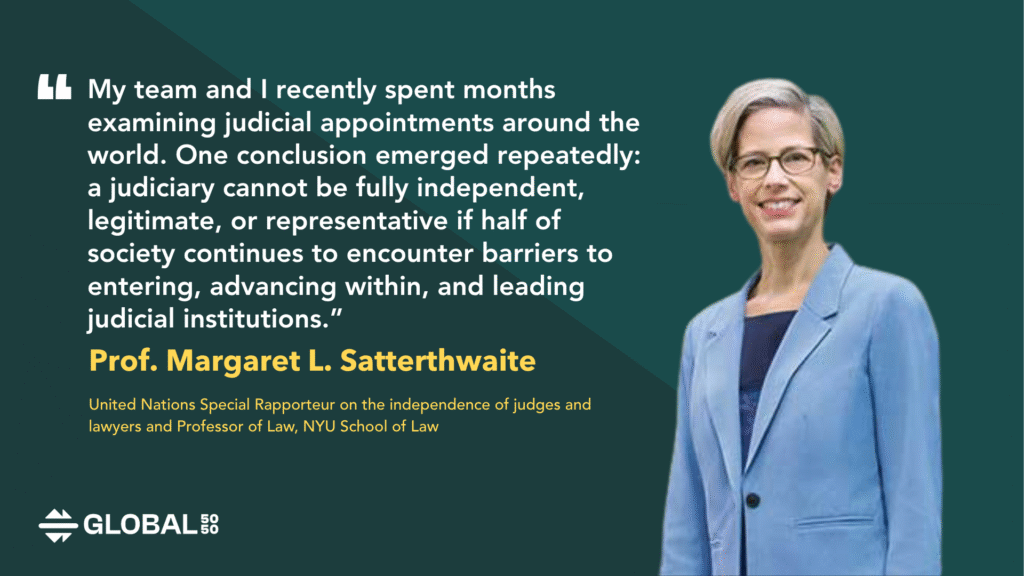
Professor Margaret Satterthwaite provided opening remarks, drawing on months of work on judicial appointments. Since women are legally eligible to become judges in most jurisdictions, she argued, formal exclusion is no longer the foremost barrier. What decides appointments now are criteria that look neutral and are not: an uninterrupted career, wide geographical mobility, elite professional networks, prior leadership. Informal circles still decide who is known when a vacancy appears. Merit, she argued, has to be interrogated rather than assumed.
Govindi Deerasinghe then presented the headline findings from Global 50/50’s assessment of 171 global law and justice institutions, none headquartered in South Asia despite their presence in and influence on the region.
Perspectives from across South Asia’s law and justice institutions
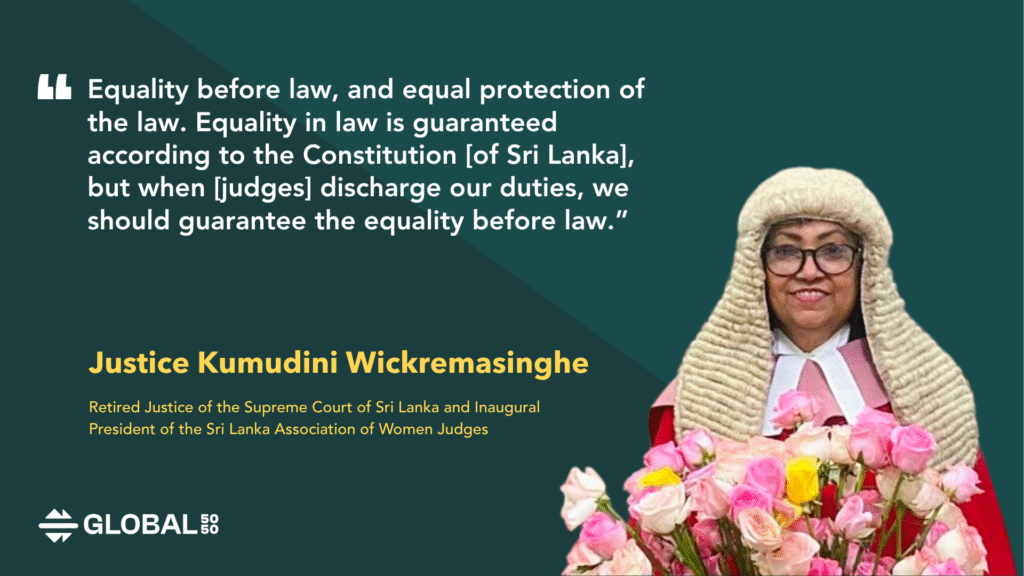
Justice Kumudini Wickremasinghe shared that very few women have reached Sri Lanka’s senior courts in two centuries of the Supreme Court, though the lower judiciary is now close to balanced. Who sits on the bench, she argued, can affect not only legal outcomes, but what happens in the courtroom: how a witness speaks when the judge is a woman and whether women lawyers, especially early-career, feel comfortable and safe representing cases in court. She asked for gender-sensitive training for judges and for the public, and the infrastructure that supports women judges to serve outside the capital.
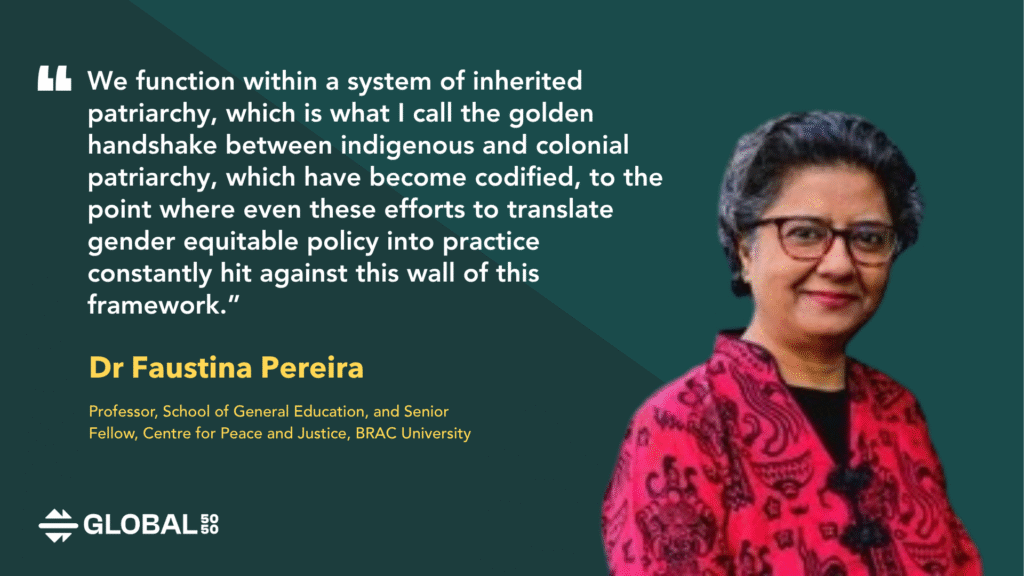
Faustina Pereira argued that the obstacle is the framework itself, an inherited legal order in which man is self-defined and woman is not defined at all, so policies written inside it keep meeting the same wall. Change comes when enough institutions adopt policies and then work through the pinch points of operating them, learning by doing rather than waiting for the perfect instrument. External shocks can force it too, from a development partner’s withdrawal to a pandemic. She asked funders to build on evidence that already exists rather than funding new efforts each time.
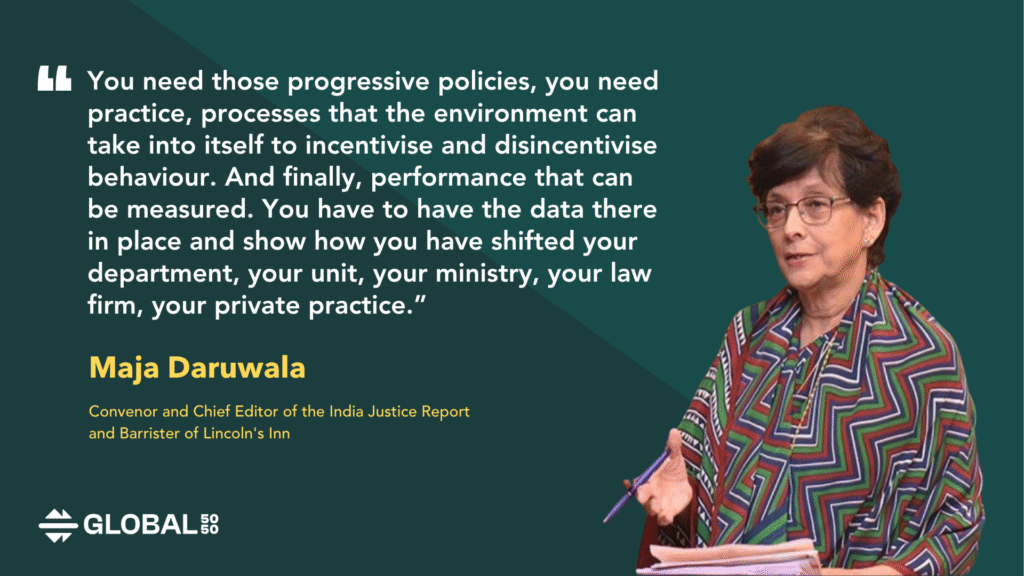
Maja Daruwala argued that institutions of justice have to be just within themselves, and that India’s are far from it across the courts, the human rights commissions, the profession and the police. Public pressure and individual cases have moved the culture further than policy incentives, alongside Supreme Court judgments and new handbooks on gender stereotypes and on the language judges use about women.
Sarah Hawkes closed on what ten years of similar reporting and accountability work in global health has taught us. Institutions rarely change out of goodwill. They change when the law requires it (as mandatory gender pay gap reporting the UK demonstrates), when their own employees and organised labour demand it, and when somebody is counting.
Global Justice 50/50 is now building recommendations with two subsectors, international NGOs and legal professional associations, to publish ahead of the report’s first anniversary in February 2027.
Read Gender (In)Justice? by subsector, find your organisation in the Gender and Justice Index, and use the workplace policy collection and the organisational change tools to test your organisation against the institutions we assessed.
Explore the data
Read the reportGender & Justice IndexLeadership in Law & Justice Dashboard
Take action
Workplace policy repositoryTools for organisational change